SIEM-01
Active
Wazuh Manager
Central monitoring platform used to collect endpoint events, display alerts, map activity to MITRE ATT&CK, and support SOC-style investigations.

CE Security Monitoring
A self-built cybersecurity lab used to generate realistic security events, monitor endpoints, analyze alerts, document investigations, and practice SOC analyst workflows.
Lab Overview
SIEM Platform
Virtual Machines
Primary Endpoint Focus
Detection Mapping
Architecture
The current lab uses VirtualBox networking to separate internet access from the internal host-only lab network. Kali Linux is used as the attacker system, while Ubuntu and vulnerable lab machines generate logs and security events that are monitored by Wazuh.
This design allows safe attack simulation, endpoint monitoring, alert investigation, and incident documentation without exposing intentionally vulnerable systems to the public internet.
The active environment includes a Wazuh Manager, Kali Linux attack workstation, monitored Ubuntu endpoint, and Metasploitable2 target. The systems communicate through an isolated VirtualBox host-only network while selected machines use NAT when internet access is required.
Network Architecture
This diagram presents the planned architecture for the CE Security home lab, including network segmentation, centralized monitoring, virtualized security systems, and future expansion.
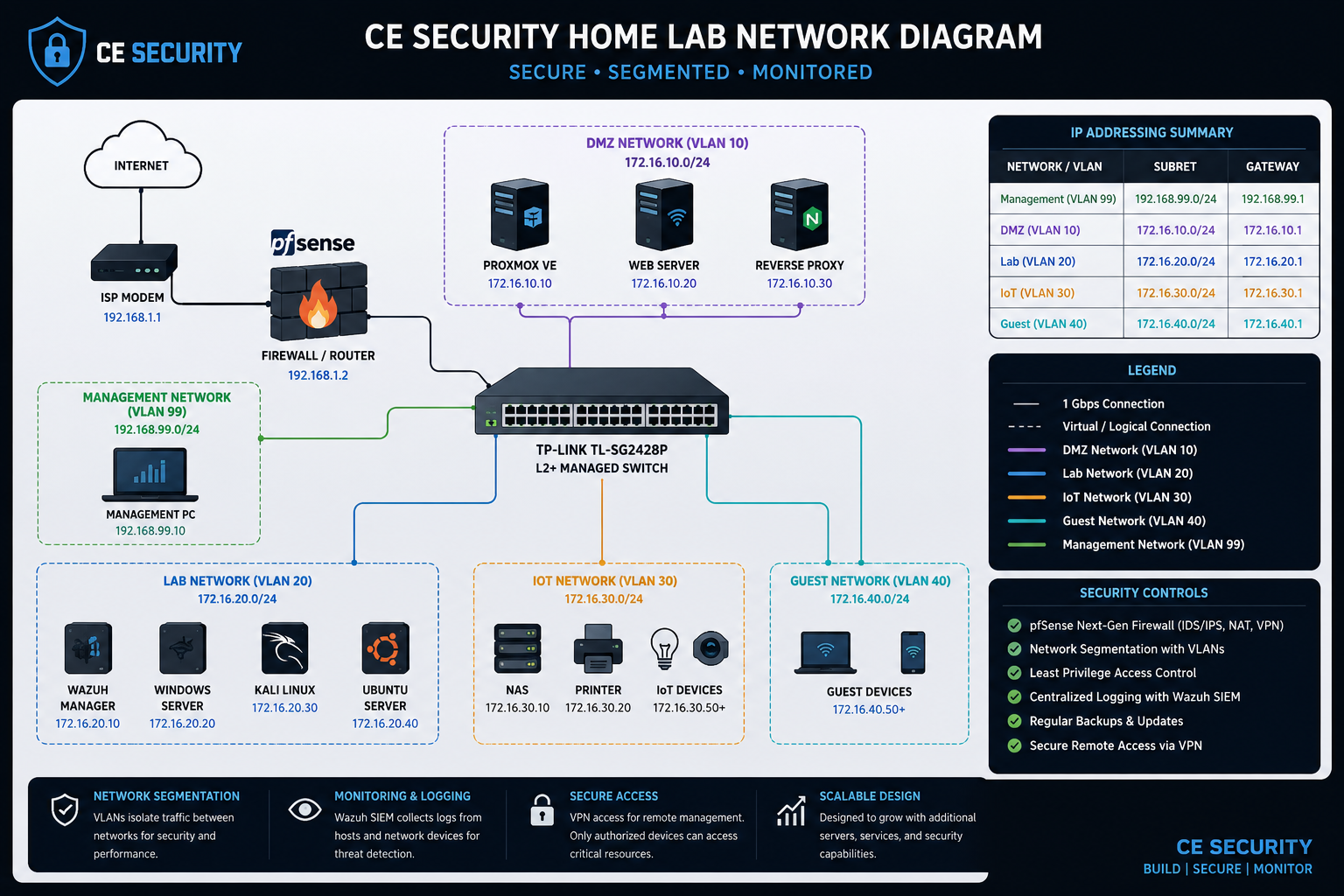
The active virtual lab currently operates on the isolated 192.168.56.0/24 VirtualBox host-only network. The pfSense firewall, managed switch, VLANs, DMZ, IoT segment, guest network, reverse proxy, and additional servers shown in the diagram represent the planned expansion of the environment.
Select the diagram to open the full-size image.Systems
Central monitoring platform used to collect endpoint events, display alerts, map activity to MITRE ATT&CK, and support SOC-style investigations.
Attacker workstation used to generate realistic events such as SSH failures, reconnaissance activity, exploitation attempts, and network traffic for investigation.
Monitored Linux endpoint used for authentication events, account changes, privilege-escalation testing, SSH monitoring, and Wazuh alert generation.
Intentionally vulnerable machine used to study attacker behavior, reconnaissance, exploitation paths, and future detection-engineering opportunities.
Workflow
Security events are generated from controlled lab activity such as failed SSH logins, privilege-escalation testing, account changes, reconnaissance, and vulnerable-service exploitation.
Wazuh alerts are reviewed to identify the affected endpoint, source IP address, rule level, MITRE tactic, event details, and supporting log evidence.
Findings are documented in professional incident reports containing an executive summary, event timeline, indicators of compromise, MITRE mapping, response actions, and lessons learned.
Completed investigations are converted into portfolio case files to demonstrate hands-on SOC skills, technical analysis, and professional security-documentation ability.
Coverage
Roadmap
Add network-based detection to monitor suspicious traffic, exploit attempts, scanning activity, and possible command-and-control behavior.
Add Windows event logs and Sysmon data to investigate PowerShell activity, process creation, persistence, lateral movement, and endpoint-compromise indicators.
Build custom Wazuh rules and detection logic for brute-force attacks, suspicious commands, privilege escalation, and malware-style behavior.
Create structured threat-hunting write-ups based on hypotheses, evidence, log queries, findings, and recommended security improvements.
Deploy pfSense to provide firewall policy enforcement, routing, network-address translation, VPN access, and traffic control between lab network segments.
Separate management, security-lab, DMZ, IoT, and guest systems into dedicated VLANs to practice segmentation and least-privilege network access.